Sunday, February 24, 2008


Sorry this picture is sideways, but I haven't figured out how to rotate pictures on this computer yet. Anyways, this is a picture of the Embassy Suites, the hotel that we stayed at last weekend in Oregon. When I saw this picture, I couldn't help but think of circuits. All the lights in the picture are pretty much the same brightness. I'm guessing that the lights in this hotel are connected in parallel and not a series circuit since it would be a lot easier to fix if one of the bulbs went out. Being in a parallel circuit means that although the voltage difference is pretty much the same, the current is different at different locations on the circuit. Thanks to the lab that we finished on Friday, I know that the current is not the same because it's split between the different branches of the circuit.

Saturday, February 9, 2008


These are pictures from our Alaska trip (yet again) when we went white water rafting. I was pretty scared at first because being the clumsy person that I am, I was sure I was going to fly out of the raft once we hit some kind of turbulence in the water (hey, that involves collisions and projectiles!). I made it though (thank God), and it wasn't as bad as I thought it was going to be. Since it wasn't hard-core white water rafting (we didn't even have to wear helmets), going through the rapids was actually really fun! It was kind of like being on one of those rides in Disneyland (except without seat belts). Anyways, on to the physics of it all...The force of the river gave our raft enough momentum so that we didn't have to do any paddling, even as we floated through the calmer parts of the river. I guess torque was also involved because our raft was pretty stable and no one fell in the water. The steersman of our raft also had to use torque and leverage through his paddles to maneuver the raft around these huge rocks sticking out of the water (when I first saw one of those things, I was sure I was going to die). Our suits also made me think of the last few chapters we studied because they insulated us from the freeeeeezing water, like how a piece of rubber or wood can protect someone from getting shocked. Looking back at the pictures, our suits also kind of made us look like weird spacemen or aquatic divers or something....

Sunday, February 3, 2008


This is from our family's annual Christmas play. The foil helmets that the boys are wearing are good conductors of electricity. That means that if a potential lightning bolt were to suddenly strike, my brother would be the one who would get hit (haha) because he's the tallest. If an electric charge were to be applied to the foil on the tip of the spear, my cousin would probably not get severely shocked since the spear has a wooden handle and wood is an insulator.

Sunday, January 27, 2008


These are pictures from New Years Eve. A lot of projectiles were involved...the ground bloomers we were all throwing in the air, the sparks from the fireworks, and the bottle rockets my cousins were shooting out of a pipe. In the second picture, although it looks like we're all about to fall, everyone was able to balance because our CM's were all supported. By leaning on each other, we were all able to widen our support areas, which helped us to stay balanced.

Tuesday, January 22, 2008


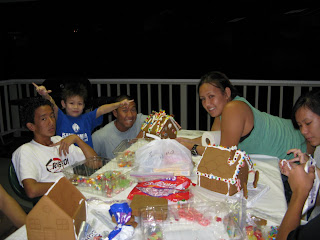
This is during Christmas break on my family's annual gingerbread-house-building day. So what does gingerbread have to do with physics? In class we learned that "all things are attracted to one another". Due to gravitational force, everyone's roofs kept sliding apart (despite the super sticky frosting we used). Because of physics, I now know that the same gravitational force that pulled the gingerbread down is also the same force that pulls the moon towards earth...Wow...Anways, all the candy we loaded on the roofs also exerted downward forces on the gingerbread houses and the gingerbread houses exerted upward forces on the candy. Everybody finally got their roofs to stick, and I have to say, they ended up looking pretty impressive =)

Monday, December 17, 2007


Riding a Ripstik involves angular momentum. You start out with zero momentum because you're not actually spinning. When you twist your upper body one way, your legs and the board rotate in the opposite direction to keep the angular momentum equal to zero. I'm not sure if you can really see it in the picture, but my brother's body is rotating to the left, so his lower body and the Ripstik rotate (sort of) to the right. Momentum is conserved because there is no external torque acting on you.

Saturday, December 8, 2007


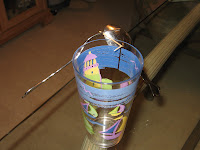
Ok, so I tried the spoon/fork/toothpick balancing thing and it actually worked :) It kind of reminded me of the balancing bird that we used for one of the labs. The handle of the fork and spoon are kind of like the bird's weighted wings that are extended below its head. That's why I think the CM is located in the air, between the ends of the fork and spoon (which I guess is the support area). This "experiment" proves that the CM is not always at the geometric center but depends on the distribution of the object's mass. It was also like the lab we recently did where we had to balance a 200 g mass at the 5 cm mark of a meter stick. The torque of toothpick's weight had to equal the torque of the spoon/fork (I think).